Years ago I opened an art shop, a small enterprise situated in an old house (fixed up) in an old neighborhood (run down) close to the business district of town. It was an area that had been trying to go commercial for years but hadn't quite got up enough steam to make a good job of it. Most of the fragile businesses were like mine, run on a shoestring, needing expensive advertising to entice the public to detour onto the premises.
It took no publicity to lure Mrs. Flum to the shop, only proximity. She lived next door, and within a week of the so-called grand opening, she popped her head through the door and inched into the deserted showroom. She had not come to buy anything, but she must have liked what she saw, and what Thadie Flum liked, she made her own. Soon, quite soon, she began to use the shop as an informal clubroom for her frequent coffee breaks.
Thadie Flum had worked in food service all her adult life, first in the public school system, then later at the county hospital. Recently retired, for several years a widow, she found time heavy on her hands. When she was getting acquainted with the shop, she seemed timid and almost reverent as if exploring the vast reaches of a foreign cathedral. She moved around uneasily, examining but not touching the merchandise and saying little. She was obviously unsure of herself in this new and strange environment, ignorant of art works and even indigenous crafts. I welcomed her eagerly, however, as a friendly presence, bringing life to my undiscovered business, and she quickly grew more confident.
I found myself becoming increasingly fond of her. She was direct and open, a rather lonely woman who had devoted herself to her work, with no children or grandchildren to fill her life, and now not even a job to occupy her time. Her visits quickly became a daily routine even after the shop began to draw clientele. She usually pulled up one of the high wooden stools I kept around the counter and would sip her coffee from that perch, eyeing each browsing customer like a protective gorgon.
But Thadie Flum didn't content herself with merely watching; as time went on, she became more sure of her role, expressing definite ideas about the merchandise, where and how it should be displayed, and she didn't mind telling me. She had a crisp way of speaking, authoritative. It reminded me of a Texan's drawl with the lower jaw barely moving, the words angled and sharp as bits of barbed wire that she spat out between clenched teeth.
"Get them place mats spread out so's folks can see 'em. They look like a stack of newspapers stuck up there on the shelf thataway!"
I had designed a rustic interior to better set off the hand-made quality of the goods, with raw beams, barn siding, and even cleanly cut logs for display tables. Mrs. Flum did not approve.
"I don't know why you want them dirty logs a-settin' around with the bark flayin' off and right out in the middle of the room in people's way. I say get them logs outa here!"
I knew my concept was right, but somehow Mrs. Flum prevailed. I called in a carpenter and had special display tables constructed.
Mrs. Flum gave freely of her opinions to customers on their purchases, too. "That picture's kindly modrun-like. You got modrun furniture, chrome and such? No? I think it looks cold--brrr! But to each his own, I always say."
Then she began answering the phone if I was in the back room. She was garrulous in person, but the telephone dried her up; she answered inquiries about shop hours or merchandise in monosyllables and hung up abruptly. I realized she saw herself as my lieutenant or, better, master sergeant to my lieutenant. Motivated by her loyalty to me and to what she considered my interests, she thought of the callers as invaders and could hardly wait to get rid of them, let alone be civil. "She can't be disturbed unless it's ver-ry important," I overheard her informing a caller.
"I don't mind, Mrs. Flum," I assured her later. "It's good business to be accommodating on the phone, too."
She reluctantly allowed that and would then call me to the phone after announcing to the caller with exaggerated politeness, "She'll be right pleased to talk to you."
Bit by bit, inch by inch, Mrs. Flum took over the shop as manager. I ordered her a cotton smock like the one I wore, so customers would know she actually worked there, and began to pay her a modest wage. Regular customers came to depend on her forthrightness in judging quality. I did, too, and within six months I had changed several lines which weren't up to snuff, according to Mrs. Flum's critical appraisal. Newcomers may have swallowed hard when first confronted by her, but soon finding her horny exterior harmless, they visibly relaxed and enjoyed her.
Mrs. Flum loved children and always carried a supply of hard candy in her pocket to give them with the whispered admonition, "Don't tell Mama about this!" When she discovered we stocked no wares specifically for children she became obsessed, pouring over merchandise catalogues during her free moments.
"Here's something," she said, pointing to coloring books with pictures of masterworks. "This is down your alley, just like them prints you sell."
"Oh, I don't know. I don't really approve of coloring books. I think children should draw their own pictures."
"What!" she exploded. "Everybody likes color books! I did myself. Why, them kiddies'll snap these up like a chicken on a worm."
Need I say that they were so popular we could hardly keep enough in stock? Mrs. Flum had the good grace to refrain from saying she told me so.
Thadie Flum wasn't so much hired as absorbed, much like the first snowfall which looks so out of place is soon taken for granted until it finally disappears into the ground. Of course, she never became so innocuous that she blended into the background completely. She continued to exasperate me occasionally, and I would have to gently reprove her misplaced enthusiasm or too chilling disapproval as not the best sales technique. But she remained in the shop as long as I owned it. When I sold it as a going concern three years later, I asked Mrs. Flum what she would do. The new owners told me they didn't want any help, couldn't afford it, and if they got anyone, he or she would be of their own choosing.
I drove by the old place a couple of months after the new owners had moved in. Crossing the lawn which separated the two houses, Mrs. Flum was heading for the door of the shop. I honked and waved, and she waved back, seeming to give me a wink. I needn't have worried about her.
I still think of Mrs. Flum from time to time. I know that the arts shop served her in some important way, but I also know that Thadie Flum helped me, too. From her, I learned that good taste is not necessarily good sense, that incongruity is refreshing, and that the human spirit which is simple and strong, untroubled by fashionable doubts, may be the finest of all.
Thursday, August 2, 2012


Tuesday, July 3, 2012
Reaching the Moho: An excerpt from THE MOHO PROVISO
 A warning light had begun to flash intermittently on Fowler’s and Mackenzie’s faces as they stood together in the glassed-in control room of the Neptune Challenger. The light seemed to keep time to the blare of a horn as insistent as a bleat of pain. They turned in unison to the heat and pressure gauges that were blinking and oscillating. To twenty-nine-year-old Mac Haber, this was the geologist’s nightmare come alive.
It was 1967, the culmination of a government project funded by the National Science Foundation. For months the always present threat of a well gone out of control hung over the state-of-the-art drill ship with each bite of earth. They were at a great depth, over 24,000 feet beneath the bottom of the ocean off the California coast. Only beyond the land mass and well into the ocean depths was the crust of the earth thin enough to attempt such a drilling project. It was deeper than any sea drilling had gone before to that magically mysterious and hitherto unexplored region between the crust and mantel of the earth, the Mohorovichic discontinuity.
Not since 1909 when Croatian seismologist Andrija Mohorovichic, while tracking seismic waves, discovered an anomaly in the area between crust and mantel had anyone ever breeched what he eventually termed the discontinuity. In this space all around the earth, both the Primary and Secondary waves changed velocity, suggesting a material other than rock, and then resumed the usual speed when entering the mantel. Now, the Neptune Challenger had finally penetrated this area. It was a risky drilling project, to be sure, and no one had expected it to be completely uneventful, though Mackenzie had been aware of some scientists’ speculations that hydrocarbons indeed comprised the Moho. Certainly, only a very few had predicted they might hit the grand daddy of oil wells, and now, that was what seemed to be happening.
This was Mackenzie’s first try at handling the threat of a blowout, a dreaded prospect for all petroleum geologists and engineers. He switched off the horn and got onto the intercom to the toolpusher on the drilling floor, who he could see was frantically sweating it out with the crew as they combated the rising deep earth pressure."What’s your mud weight, Joe?"
"Sixteen pounds per gallon."
"Get it up to nineteen, quick!"
Joe Scudder’s sunburned face creased into furrows of doubt. But as an experienced drilling floor supervisor, he didn’t have to be told twice. He gave a wave of assent and led several men to the mud tanks to prepare the heavier density mud. Time. That’s what they needed to determine the extent of the problem and how to correct it.
"Where’s Danzig?" Fox growled.
Mackenzie looked out over the drilling floor and saw the engineer appear at a flight of stairs leading from the bottom of the vessel. He spent most of his time there, tinkering with the engines. He bounded to the console and entered breathless.
"Is it trying to blow?" he asked needlessly, scanning the gauges. "What have you done for it, Mac?"
"Mud weight to nineteen. It should take Joe about fifteen minutes."
"We’ll never make it. Look at that pressure!"
"Can you recommend anything else?" Fox asked sarcastically.
"The temperature’s been rising too," Mackenzie noted. "Up to nearly 300 Fahrenheit. That complicates things." His mind was racing. Too heavy mud could crack the formation rock and instigate a blowout. But it just might work.
Danzig turned to him. "It’s going to blow!"
"How high could it go?" Fox asked him. "Should we use the Blowout Preventer now?"
Danzig didn’t answer but gave a brief, uncertain look at Mackenzie. The geologist was watching the gauge as it rode even higher with its rocketing cargo of energy. It was now registering 18,000 pounds per square inch and still climbing.
Oil and gas flooding the well bore," Fox muttered. "I still can’t believe it."
"We won’t be able to hold it, Fowler," Mac said tensely. Everything he’d learned about extracting from deep reserves seemed worthless at the moment. They were making history.
"The Blowout Preventer?"
Fowler had no sooner spoken than a fountain of viscous mud and oil spewed from the well with the force of a bomb. It was starting to go. Clouds of steam shot above the ship like the spume of a whale. Crewmen tried to back away from the torrent but were instantly covered with mud and oil. Joe Scudder ran to turn on the valve that would carry the flow to the recovery tank.
Leo Danzig seemed frozen in place with clenched fists at his sides.
"Close the goddamned BOP rams," Fowler shouted at Leo.
At the command, the engineer leaped out of the console to a nearby control panel containing the hydraulic system for the Blowout Preventer. He switched on the motor, which gave out a deep throated roar that vibrated within the control room, and maneuvered the gears that would activate the experimental equipment. Although developed for this very purpose, the BOP had never been field tested to control this much force, not an unusual circumstance.
The console door stood open, and they caught the unmistakable odor of the gases associated with crude oil. Then the BOP gears meshed and the grating sound of steel on steel signaled the movement of the mechanism.
Thirty agonizing seconds passed before the men in the console felt the impact of the giant set of jaws, the equivalent size of several stories, closing the space between drilling steel and casing on the ocean floor. The mud pump gauge began to fall until it finally registered zero. "Thank God it worked," Fox rasped. He took out a handkerchief and wiped his sweating face.
"It’s leveling off at 15,000," said Mackenzie.
Leo smiled wanly at Fox. "We made it."
Mackenzie, too, looked at his superior. Fox’s face was blotchy as he seemed to struggle with conflicting emotions. No one spoke until Joe Scudder entered the room with pieces of the exuded rock. Mackenzie thanked Scudder as he went back to the floor and then took the samples to his small lab along one wall of the console.
"No doubt about it," he said finally. "This looks as good as any samples I’ve seen in the oil fields. The rock chips are saturated."
Thirteen years ago that terrifying experience took place, followed by a memorable conversation in Fowler’s little guest cabin. They had been arguing, or rather Fowler had taken the time to override Mackenzie’s objections that the news of the discovery couldn’t be told.
"Keep it under wraps?" Mackenzie sputtered, incredulous. As Project Geologist, only one year on the job and fresh from a four-year stint in the Navy, Mackenzie was keenly aware of his low status with the Vice President of Gravely and Fox. Still, he had to try, so he calmed himself and began to marshal his best arguments to his boss.
"But, Fowler, this upsets the textbook theories. Believe me when I say that with this information, the academics will have to recant their theory of fossil degeneration as the source of oil. It’s an incredible find. And weren’t we and our sponsors hoping for this result?"
"Not quite. We were hoping to prove the negative." Fox stood up in the tiny cabin, reserved for his occasional visits from Houston. "Nobody needs to know we’ve disproved the accepted geological theory."
He walked to the porthole and looked at the sea, which seemed to have grown muscles as heavy weather threatened. "I gotta get out of here pronto. You, too, and Leo. I want both you boys to come to Washington with me. We’ll pick up Mr. Gravely and our things in Houston and take the first flight out. We’ve got a meeting with the President, a private meeting."
Tuesday, May 29, 2012
Cheek by Jowl: A Southern Story
I was there when they died.
I had worked there summers my junior and senior year in high school and most weekends, picking up trash around the place, mowing and gardening, doing whatever Joe Fred wanted. He liked to order me around, sitting in a sloping lawn chair, his navy blue dress pants pressed sharp, his white shirt unbuttoned at the neck.
"Boy, you tend to the bean runners properly. They'll rot if you let them drag on the ground. I've never seen such stupid, slovenly work."
Miss Frances would get him all wound up the way she'd pick at him, so he'd get on me or on the servant girl Liz.
Joe Fred was a real dude, his hair barbered every two weeks, his shoes pissy clean, just like he was a man of fortune when all he was was Miss Frances's dog. She'd taken him on to work for her years ago, out of the gutter, really, my mama said, when his drinking was terrible. His family was educated, though Joe Fred was not. He couldn't settle to anything, studies or a job, and that with his father being the headmaster of a small private school. His brother had done all right, though, retired from the Forestry Service; he didn’t have much to do with Joe Fred. Only Miss Frances, now so old she was like a dry tea leaf, had settled him down.
Each morning, Miss Frances would call Joe Fred into the large front parlor to go over accounts. Joe Fred collected eggs from a few chickens along with the vegetables he raised, with my labor, and sold the eggs to a local grocery store and the vegetables to truck farmers for their roadside stands. She'd count the money and hand over Joe Fred's percentage.
Miss Frances had plenty of money. No children, an old maid, but she had three nieces she hated who wanted the big house and whatever else they could lay claim to. Miss Frances showed them the door regularly.
Joe Fred always acted fierce like he owned the place. He was disrespectful to Miss Frances in front of her, calling her names under his breath like "pecky sparrow" and "old creaky bones." If she heard, she ignored him. But she'd complain to him about things. If he took an occasional snort, she called him a "drunken sot." She told him he was lazy and didn't get enough work out of Liz or me.
"I've got dust kittens under my bed," she'd shriek in her funny old lady voice. And Joe Fred would get Liz to take a swipe with a dirty mop to please her. He never actually disobeyed her. Miss Frances couldn’t stand to be contradicted.
The upstairs was filthy. It had been shut up for years and was nothing but a storage bin for old furniture and junk. Except the attic where Joe Fred lived. I'd been there once at Miss Frances's command to locate Joe Fred.
"Probably nursing a hangover," she said, her voice matter-of-fact. I was not supposed to say a word about him though.
I picked my way through the stacks of chairs, boxes, an old organ, several dressers and cupboards to find the door to the third floor. I had to go up a winding, narrow stairway lighted from afar by the window in Joe Fred's little room. He had made a place for himself in a section of the attic. He was laid out that day, bathed in fumes from the whiskey. He didn't always smell of drink. Just on his bad days
Toward the end of that last summer, I was mowing and it was hot. I had permission to come in for lemonade mixed up by Liz and kept in a pitcher in the refrigerator. Liz had gone to her duties in another section of the house so I was alone when I heard raised voices from the front parlor. I eased my way through the darkened back parlor, never used as far as I could tell, and stood by the open door, listening shamelessly. Miss Frances and Joe Fred were arguing.
But Miss Frances’s voice was weak and at first I could catch only a word now and then: "draw up papers," and "legal and binding." Then I distinctly heard her say, "you’ll marry me." I peeked around the corner and saw that she had leaned forward, staring up into Joe Fred’s face.
At those words he reared back as if she’d struck him, muttering something. Miss Frances went on, clearer now, her kazoo voice all in her throat. "My nieces won’t get a thing." She said something about "common law," and I figured she was setting up a marriage and a will that couldn’t be broken, that involved Joe Fred in a way he couldn't abide.
He’d begun to pace in short steps in front of her, this way and that. He reminded me of a polar bear I’d seen at the Zoo, confined to a tiny cage in the heat of the summer. All he could do was take a step or two and turn, over and over, in his frustration and anguish.
Then Joe Fred paused and shouted, "I won’t do it. You can’t tie me up like that!"
Miss Frances started to rise from her chair, holding out a tiny claw to catch at him, but he fended her off, shoving her backwards. She fell with a snap of her head into a corner of the chair, a bundle of lace and bones.
I crept back into the kitchen. I had finished my drink and put my glass in the sink when Joe Fred came in. He had a funny look on his face.
"I guess you'd better call someone. The old thing has had a stroke maybe, maybe died, I think. I don't feel so good. I'll be in my room." He turned and went up the back stairway from the kitchen to the second floor to avoid the parlor, I guessed.
The phone was in the front hall, and after dialing 911, I slipped into the parlor and saw that Miss Frances was in the same collapsed position. I went back to the kitchen to wait for someone to come. Soon, Liz started screaming. She had come from somewhere in the house and discovered her mistress. She ran into the kitchen with wild eyes. I told her we had to wait, and we sat at the kitchen table without saying a word. Once I thought I heard some commotion upstairs or maybe outside, but I didn't think much of it.
They came with sirens blaring. I ran out to the driveway and noticed Joe Fred right away. He was lying on the sidewalk. For a minute I couldn't get it straight. I thought he’d tripped, hit his head. I wondered how he’d come out without me knowing. I remember thinking, "The front door?" The ambulance driver saw the blood.
"Is this the casualty?" he asked me, stooping over the body. "Must have come from that window up there." He pointed to the open attic window and then leaned toward Joe Fred's face to examine the wound. "Dead all right, broken neck. And smells like a distillery. Must have lost his balance and tumbled out."
I didn't say anything.
Tuesday, May 1, 2012
JFK, Charlton Heston, Johnny Cash, et al: Close Encounters of the Famous Kind
First of all, I am not a celebrity hound. In fact, I go out of my way to appear unfazed at the appearance of anyone of note who comes within my ken, and there have been more than a few. Living for many years as I have in the Nashville area, celebrities are bound to show up no matter where one goes. At one time, our suburb boasted over sixty country music stars in residence, including Johnny Cash, Roy Orbison, Barbara Mandrell, and Boots Randolph. (Tammy Wynette lived two doors down from our first house, and William Lee Golden of the Oak Ridge Boys lived across the street from our second one.)
My own personal experience with celebrities began earlier, however, after my January graduation from high school in Des Moines, Iowa ( at that time they had midyear students). I didn’t want to start college until the fall, so I got a job in the advertising department of the Des Moines Register and Tribune. One day a buzz went around the office that Charlton Heston was in the building and would be signing autographs in a certain room at a certain time. My co-workers all wanted to see him up close, so I too went along out of curiosity.
The great actor was in his prime then, having just finished making The Ten Commandments, but my first glimpse of him after standing (foolishly, I felt) in a long line was a little disappointing. He had on a khaki jacket and casual shirt, sitting behind a desk and looking singularly bored. Finally, I approached him, standing mutely by his side. I don’t think he more than glanced at me before he signed his name on a tiny slip of paper. The only other thing I recall as he bent his head to write was seeing a wart on his neck. Then it was over. I put the slip away in my box of mementos, along with letters from old boyfriends and dance programs. As time went on, those mementos got thrown out, as did the autograph.
A few years later, my husband and I were living in Cedar Rapids where I was employed in the business office of the telephone company. One day, my manager tapped me and two other account representatives to take charge of the communications tent at a multi-state event called the Corn Picking Contest. President Eisenhower would be there to say a few words to the crowd of over 100,000, and also putting in an appearance was the Democrat hopeful for the upcoming election, Senator John F. Kennedy. The communications tent was a hub of activity in those low-tech days, for all the reporters called in news from one of the many phone booths in the large tent. I and my co-workers would then get a call-back from the operator with charges.
Soon after we got set up, a flurry of activity outside the yet virtually empty tent heralded the arrival of someone important. In walked a tall gentleman, who scanned the area, followed by the man himself. Senator Kennedy immediately spotted us at our desks and with a friendly (and no doubt practiced) smile approached us with hand outstretched. He introduced himself and chatted briefly about the venue and then departed. It was over in a few minutes, but later I could say I shook the hand of a President of the United States in a rather intimate setting. As far as Ike was concerned, I only saw him from a distance when someone lifted me onto the bed of a truck for a minute when he was speaking.
It wasn’t until several years later that we made our home in Tennessee and I again came face to face with notables. As I mentioned, this area was a hotbed of celebrities of a certain kind–and still is to a lesser extent today. Shortly after taking up residence in the town, which was only about 16,000 at the time (it’s now about 50,000), I took our young boys to a small public pool. It was there that I began to see Johnny Cash with his (or rather June’s) daughters, about the same age as my sons. No one ever paid any attention to him, and he usually wandered around the perimeter while the girls swam. I liked to take a rug and sit on the nearby grassy bank. Occasionally, he also sat down, sometimes close, sometime far from me. He might nod a little greeting, but never spoke; nor did I. Hardly the man in black, he invariably wore jump suits in various colors.
In reflecting about these brushes with the famous, I’ve decided that though we get a kick out of mentioning our encounters, they are really quite meaningless; we know these people are no different from anyone else, only more accomplished in certain areas. One can admire them for their talents or even for their character, if indicated, such as my observation recently of Reba McEntire at a local restaurant. As is my wont, I refused to stare, but I couldn’t help but observe that when she saw a young sailor dining alone, she sent word for him to join her party. It was a thoughtful, entirely unnecessary act, one that probably went unnoticed by most people in the restaurant, but it will always color my regard for her. That kind of memory is more meaningful, from my standpoint, than clustering around for an autograph that will probably fade or get lost over time.
My own personal experience with celebrities began earlier, however, after my January graduation from high school in Des Moines, Iowa ( at that time they had midyear students). I didn’t want to start college until the fall, so I got a job in the advertising department of the Des Moines Register and Tribune. One day a buzz went around the office that Charlton Heston was in the building and would be signing autographs in a certain room at a certain time. My co-workers all wanted to see him up close, so I too went along out of curiosity.
The great actor was in his prime then, having just finished making The Ten Commandments, but my first glimpse of him after standing (foolishly, I felt) in a long line was a little disappointing. He had on a khaki jacket and casual shirt, sitting behind a desk and looking singularly bored. Finally, I approached him, standing mutely by his side. I don’t think he more than glanced at me before he signed his name on a tiny slip of paper. The only other thing I recall as he bent his head to write was seeing a wart on his neck. Then it was over. I put the slip away in my box of mementos, along with letters from old boyfriends and dance programs. As time went on, those mementos got thrown out, as did the autograph.
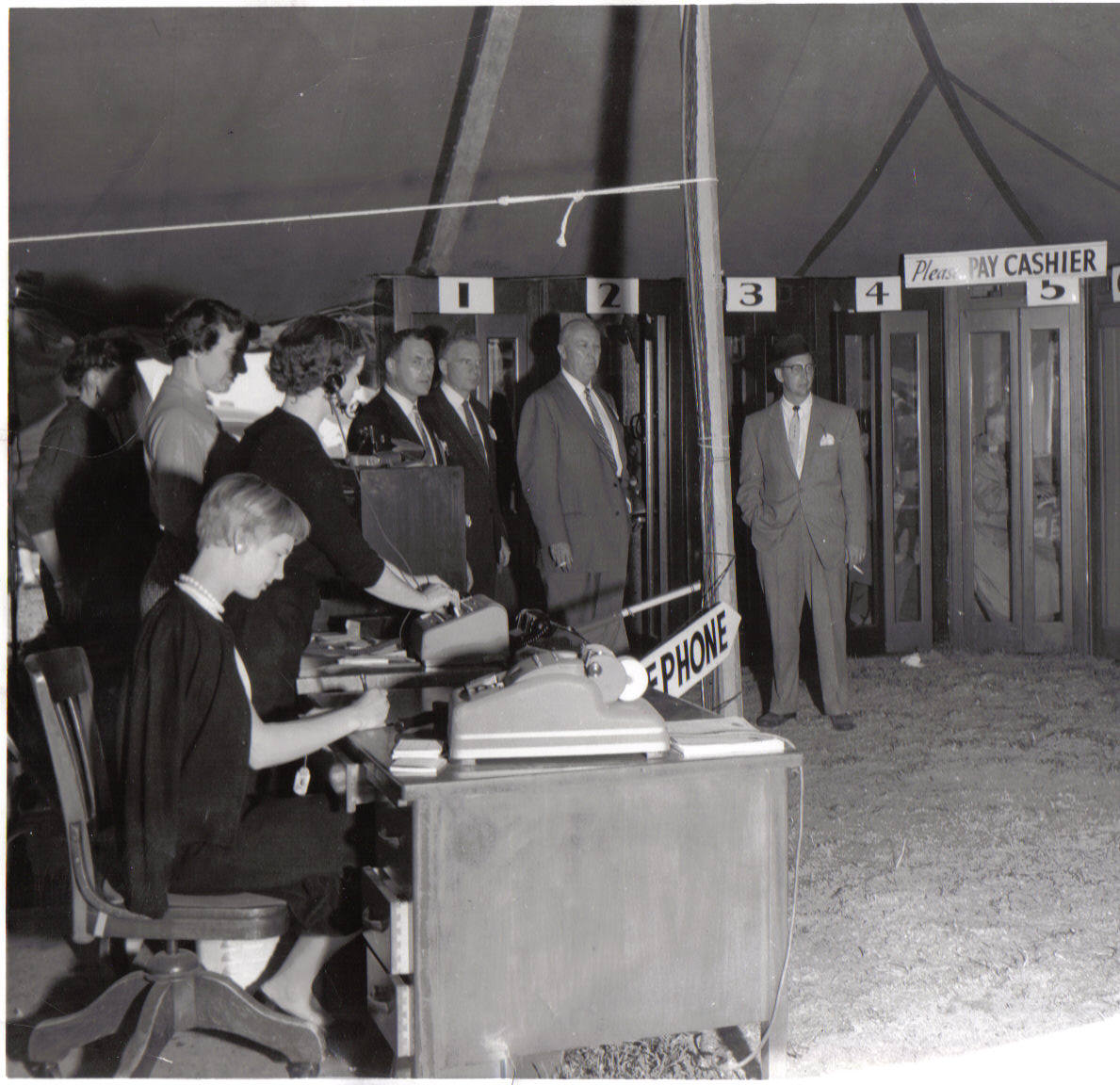 |
| Jeanne seated in the communications tent |
Soon after we got set up, a flurry of activity outside the yet virtually empty tent heralded the arrival of someone important. In walked a tall gentleman, who scanned the area, followed by the man himself. Senator Kennedy immediately spotted us at our desks and with a friendly (and no doubt practiced) smile approached us with hand outstretched. He introduced himself and chatted briefly about the venue and then departed. It was over in a few minutes, but later I could say I shook the hand of a President of the United States in a rather intimate setting. As far as Ike was concerned, I only saw him from a distance when someone lifted me onto the bed of a truck for a minute when he was speaking.
It wasn’t until several years later that we made our home in Tennessee and I again came face to face with notables. As I mentioned, this area was a hotbed of celebrities of a certain kind–and still is to a lesser extent today. Shortly after taking up residence in the town, which was only about 16,000 at the time (it’s now about 50,000), I took our young boys to a small public pool. It was there that I began to see Johnny Cash with his (or rather June’s) daughters, about the same age as my sons. No one ever paid any attention to him, and he usually wandered around the perimeter while the girls swam. I liked to take a rug and sit on the nearby grassy bank. Occasionally, he also sat down, sometimes close, sometime far from me. He might nod a little greeting, but never spoke; nor did I. Hardly the man in black, he invariably wore jump suits in various colors.
In reflecting about these brushes with the famous, I’ve decided that though we get a kick out of mentioning our encounters, they are really quite meaningless; we know these people are no different from anyone else, only more accomplished in certain areas. One can admire them for their talents or even for their character, if indicated, such as my observation recently of Reba McEntire at a local restaurant. As is my wont, I refused to stare, but I couldn’t help but observe that when she saw a young sailor dining alone, she sent word for him to join her party. It was a thoughtful, entirely unnecessary act, one that probably went unnoticed by most people in the restaurant, but it will always color my regard for her. That kind of memory is more meaningful, from my standpoint, than clustering around for an autograph that will probably fade or get lost over time.
Sunday, April 1, 2012
Downton Abbey Revisited
 |
| Branson and Sybil |
A beautiful setting, authentic costuming, many interwoven and compelling stories as well as an interesting transitional period in history all combine to keep viewers enthralled. I’ve read pans on this series that call it a “soap opera”even as news stories tout it having a record audience of any PBS program in its history. Pretty good soap opera, I’d say! Upon seeing the initial episode, I was delighted with the excellent casting. Nothing ruins a dramatic work for me more than actors playing inappropriate roles. Speaking of well-played roles, Elizabeth McGovern as Lady Grantham is the one American with a regular part. Yea! As for the characterizations, I was a little put off at the outset by the unpleasantness of Lady Mary and Lady Edith, the two older daughters of the Earl of Grantham, portrayed convincingly by Hugh Bonneville. Of course, these unhappy girls had much to worry about with the oldest needing a new husband since her betrothed was a casualty of the Titanic, and her sister, the jealous and less pretty one, seeing little hope of catching any man for herself. During the course of the dramas, however, both daughters would become changed and thereby redeem themselves.
But despite these early blips in likability, I became entranced with the emerging circumstances that would inform the plots. Scenarios began to unfold, one upon the other above and below the salt, quite a daunting task for the author, considering there are sixteen main characters. A new heir to the title comes on the scene, the smooth and handsome Dan Stevens as Matthew, who fails initially to appeal to Lady Mary, and later has another personal difficulty to deal with. Then Branson the chauffeur, well played by the engaging Allen Leech, finds himself attracted to the lovely Lady Sybil (Jessica Brown-Findlay), the youngest, most liberal, and most charming of the daughters. Their slow-burning romance is fascinating, since Branson has decided views on the aristocracy, but ultimately satisfying, as well it should be, considering how daring it is.
Downstairs, amid a kind of continual chaos, other romances are taking place, one between a housemaid, Anna, and a valet, the long-suffering Bates, with their complicated relationship; the other romantic alliance is one between a dying footman injured in World War One (a traumatic and important event in the story) and the kitchen maid. Also among the servants are a couple of ruthless plotters who make life difficult for anyone they don’t like.
If all this sounds impossibly complicated, I can assure you it is not, mainly because of the writing talents of the creator and writer, Julian Fellowes, whose credits also include Gosford Park. In Downton Abbey, Fellowes uses a dramatic technique that works well in keeping the viewer always engaged and able to follow various plots and sub-plots. Never was I confused as to who was doing what, mainly because each dramatic segment was never more than a few minutes long, cutting from one scene to the other. Thus, it was easy to keep up with the different plots; longer scenes might require an update or review when going back and forth.
I was so enthusiastic about the series that I purchased the DVDs and have played them almost compulsively over and over. Because of this, I have become aware of certain amusing authorial quirks, which writers seem prone to do in their writing. One of my sons, for example, noted that in my mystery novel, Murder at Toll House, I said “anyhow” way too much. Since it is an e-book, I was able to easily correct my habitual use of the word. Julian Fellowes has virtually every character say, when surprised or shocked, “What?” rather than an extended question such as “What do you mean?” or “Is that so?” or “Why do you say that?” No, everyone says, “What?” In addition, I seem to have heard “quite right” and "fetch" a few too many times. This isn’t a big deal, and I don’t really criticize it as a serious fault, but I found it interesting as a fellow writer that even one as experienced and clever as Fellowes falls into inadvertent repetition. Sometimes I noted anachronistic intrusions, too, such as Matthew telling his mother that his fiancé Lavinia was “sucking up” to her. Really? I doubt that was an Edwardian expression. There were other glitches, but so few and so unimportant to the whole they do not bear mentioning.
Altogether, as I have said from the start, I love the two productions so far, and I’m looking forward to Series Three, unfortunately not appearing on the PBS schedule until next January. I and the other souls addicted to Downton Abbey will simply have to watch the first two series again and again on disks until our desire for more can be satisfied with the new production–and then hope for yet another and another.
Friday, March 2, 2012
White Knuckle Driving
I learned to drive in a city, so maybe that’s why I still feel most comfortable going from stores to shops to malls and back even in fairly heavy traffic as opposed to highway driving. I set off on any trip that takes me onto an interstate with a white-knuckled grip on the steering wheel. After only a few miles on the road, my neck begins to grow stiff--immovable, sometimes, and my fingers have turned into claws that are strangling the wheel. And it’s all because of certain drivers that I consider road hazards. Maybe my concerns will strike a chord with other nervous drivers.
The most prominent and disturbing hazard that roams the interstates is the Careening Semi. This behemoth is like all bullies everywhere. Because of its size advantage, it rules the road; wherever it wants to go, it goes. Even when it is sedately traveling the speed limit, it always seems to be advancing in a menacing way toward the innocent, undersized passenger car. If a Careening Semi gets angered because a mere car has not moved out of its way quickly enough, it may give a frightening bellow of its horn as it threatens to run up over the back of the car. In days of yore, truck drivers were called "knights of the road." They helpfully blinked for safe passing or warned of lurking highway patrol cars and generally were paragons of safety and courtesy. I have found a few latter-day truckers to follow these standards, but sadly more often than not, they strike me as capable of turning on the motorist with all the chilling fervor of the anonymous driver in Duel, a 1970s movie that realizes my worst fears.
The second most aggravating hazard is the Spoiler. You can spot these little devils in your rear-view mirror as fast moving vehicles darting from lane to lane, pulling in dangerously close, whipping onto the shoulder or turn lane around cars that don't move quickly enough. These cars may be any make, but they are always either black or red, low slung, and have a saucy little spoiler on the back which seems to taunt, "Up yours!" These cars are driven by teen-age boys or slightly older ones of a teenage mentality. My tendency is to move away from the Spoilers, or even try to outrun them (I may be tense, but I'm not slow). This maneuver is doomed to fail since they are egged on by any suggestion of competition. With the Spoilers, slow and steady, the philosophy of the tortoise, wins the race. Changing lanes unless absolutely necessary is risky, for even though they have quick reactions, you may not get in the lane fast enough, and they could easily side-swipe you.
Drivers Lost in Space are not as dangerous as they sound, but they can be extremely annoying. Lost in Space might be a mother trying to corral the back seat which is full of fighting, crying children, a businessman mentally going over his presentation, a woman checking her makeup or hair, or merely someone deep in thought or conversation with a passenger. These drivers may be seen coming onto the interstate from a ramp without a glance at converging traffic. If they noticed the "yield" sign, the letters didn't add up as an instruction to them personally. The best way to avoid Lost in Space is to get by them quickly since all Lost in Spacers are narrowly focused if not myopic and could swerve in front of you at the drop of a hat.
Lastly, Gramps is the driver who believes himself to be the safest on the road but is perhaps (after the Spoiler) the single greatest cause of accidents. Gramps may be either sex but is almost always old (some younger persons are so afflicted), and maybe with eye problems. Gramps may be spotted from behind as an apparently driver-less car in the right-hand lane going excessively slow. Closer inspection reveals a short person who must view the road through the steering wheel. They can, however, see out the side windows, and many seem to be out to look at the scenery, as are their passengers who stare intently out the window beside them. Probably Gramps has learned to drive in another day and time. I seldom drive in the far right lane, particularly when traveling on a hilly, curvy highway. Coming up on Gramps suddenly at a high rate of speed means taking drastic avoidance measures--screeching brakes or running onto the shoulder. When I see a long string of traffic creeping along, I know what I will find--an old timer nonchalantly leading the pack.
No method of dealing with my fears and frustrations on the highway is perfect as one might guess from these descriptions, so I make every effort to keep my husband comfortable behind the wheel on trips, long or short, and encourage other relatives and friends always to be the designated driver as a favor to me and my nerves.
Monday, January 30, 2012
Glimpses of American Life in Prose Poems
An American Story
Berta was her name, a girl with woman’s eyes
Slanted into the high bones of her cheeks.
The skin a soft tan, all suggesting a bygone
Melding with a native race in upper Norway.
She wasn’t pretty but playful and daring
Loving the merry parties her parents
And the neighbors gave for the many
Festive occasions that brought out the wine
And dancing to spirited fiddle playing.
Then came the Western Awakening,
With all the fervor of re-found faith.
It swept across Northern Europe
Led by a body of converted priests
Who declared the parties frivolous
If not evil with their drink and dance,
Keeping the faithful from sober thoughts.
The fiddles were banished to dark attics,
Their sound too seductive and plaintive.
But it was decreed that on certain
Occasions where music was allowed
Accordions were less sinful as a kind
Of small, secular organ that reminded folks
About the need for decorum and piety.
Berta silently railed against the changes,
Feeling stifled, and with her restless
Spirit she sought out the nearby harbor
To sink herself into the motion of the sea,
To watch the ships and men who glanced
At the womanly girl with slanted eyes.
A bold sailor in port for a week
Got her talking and then meeting
Where they came to know each other
Not wisely and too well.
Berta’s mother told her father about
The baby, so he cast around to find
Some likely lad that would take the girl
And the shame away from their proud name.
He paid a young man called Reinert
Fifty kroner if he would marry Berta
And leave for far flung parts
With an eye for the main chance and
Aware of vast lands in the New World,
Reinert agreed, and they sailed off
On their long journey, a sick-making
Affair for Berta, who before it was over
Lost the baby but not Reinert who stuck
By his bargain and made the best of it.
They settled in the great Midwest where
They raised crops along with two daughters
And four sons who made them proud,
The beginning of an American dynasty
Of farmers, housewives, teachers, lawyers.
After some years of rich harvests
Berta and Reinert welcomed her parents
To make their own fortune in this favored land.
Fear and Favor
In the summer of ‘49 the polio epidemic hit the Midwest.
No more swimming at the pool with my friends
Or staying up to watch our new TV until ten.
“Bedtime,” my mother would say with a little frown
To remind me that times were dangerous
And disease on the rampage.
We traveled to my aunt’s wedding in Minneapolis
Where children were dropping like flies.
I remember covering my mouth and nose
With my dad’s hankie as we drove through the streets.
Back safely home, I now and then
Dipped my head to my chest as a test to see
If paralysis was creeping up on me unbeknownst.
But all seemed well for me and my friends
Until one August evening, when my mother,
After a hushed conversation on the phone,
Sat me down in the kitchen and told me
That my friend Marilyn had been taken by ambulance
To the hospital, with polio, the bad kind, too--
Bulbar, which sometimes killed.
She went into an iron lung, a horrifying machine
That would save her life, I understood.
We later heard a strange thing;
Her sister had kissed her goodbye on the lips,
And hadn’t gotten sick, so we wondered
About the curious nature of this disease.
I was too young to visit her until she came home
Months later, from a place in Oklahoma
Where great strides had been made to keep limbs
From twisting and shrinking beyond use.
Marilyn did recover with only a slight limp that
Got better until it was unnoticed by most folks.
Yet she went to a school for the handicapped
Because she hadn’t the stamina for regular school.
I haven’t seen her for fifty years but I knew
She’d married and had a family of her own.
I now have heard the symptoms may return
Years later when victims thought themselves cured.
Again, fear must be stalking Marilyn
And I remember the summer of ‘49.
Big Wheels
It was while driving along
Through Arkansas that we felt
Oppressed, as if we didn’t belong,
Sandwiched between two semis,
With trucks rolling by on both sides.
Not just the big rigs that roam
Interstates and roads,
but bullying pickups and dualies.
We were outclassed, outsmarted,
In a word, small.
We drove farther south and west,
Trucks keeping up their threats,
Riding our bumper, honking, passing.
We stayed away from gas stations
With blaring signs of, “Truckers Welcome!”
We shopped a long while for a motel
Where the hulking beasts weren’t parked
And set off next morning at the crack of dawn
Hoping to steal a march on them.
But wise to the trick, they soon came along.
If Arkansas is a terminal for trucks,
Texas has to be a truck haven.
They live here, maybe breed here.
And worst of all, they seem fighting mad.
The other day while waiting at a stop light
We were rear-ended by a small truck.
At a local eatery we watched in horror
As a truck backed into our car like it wasn’t there
Often they pass me with no room to spare
Then forced by a red light to stop, pant, and paw.
We haven’t relented yet,
Refusing to give in to the mania.
Or maybe the truck that suits us
Hasn’t yet been made.
But I must admit I’ve been eyeing
Certain big wheels that take over the road
And I’ve wondered, really wondered
What it would be like to get behind the wheel
Of a gravel truck so I could yell,
“Just eat my dust, you all!”
And from the sky . . .
Far down our canal we spied a black cloud,
Startling, ominous.
It grew nearer and shattered
Into hundreds of cormorants
Who skimmed along the calm surface
And settled in to take a look around
Before they ducked and dived
To make their catch, tasty and alive.
Then we saw pelicans in their wake,
Ponderous, huge amidst the churning water,
Snatching fish too large for smaller gullets.
Soon egrets came in dazzling white array,
Posing with regal grace on piers.
Choosy, we thought, until we saw one
Die before our eyes with neck distended
From the greedy burden of its prey.
The great blue herons cruised in last
On the path of their heralds,
Sank down on grassy banks
To wait with the dignity of rank
For their meals to be brought on a tray.
Above the fray, the seagulls screamed and laughed
Assured they’d soon have the scraps.
Three mornings this spectacle occurred,
Then stopped, never that season to return.
Those in the know said these forays
Stripped the waters of breeding fish
Retreating from the chilling bay.
Guided by their instinctive need
They met their doom
On the quiet canal
While the birds shall live another day.
Jeanne Irelan
January 2012
Subscribe to:
Posts (Atom)