On Writing

"Every fine story must leave in the mind of the sensitive reader an intangible residuum of pleasure, a cadence, a quality of voice that is exclusively the writer's own, individual, unique."
Willa Cather

Tuesday, May 1, 2012

JFK, Charlton Heston, Johnny Cash, et al: Close Encounters of the Famous Kind

First of all, I am not a celebrity hound.  In fact, I go out of my way to appear unfazed at the appearance of anyone of note who comes within my ken, and there have been more than a few.  Living for many years as I have in the Nashville area, celebrities are bound to show up no matter where one goes.  At one time, our suburb boasted over sixty country music stars in residence, including Johnny Cash, Roy Orbison, Barbara Mandrell, and Boots Randolph.  (Tammy Wynette lived two doors down from our first house, and William Lee Golden of the Oak Ridge Boys lived across the street from our second one.)
    My own personal experience with celebrities began earlier, however, after my January graduation from high school in Des Moines, Iowa ( at that time they had midyear students).  I didn’t want to start college until the fall, so I got a job in the advertising department of the Des Moines Register and Tribune.  One day a buzz went around the office that Charlton Heston was in the building and would be signing autographs in a certain room at a certain time.  My co-workers all wanted to see him up close, so I too went along out of curiosity.   
    The great actor was in his prime then, having just finished making The Ten Commandments, but my first glimpse of him after standing (foolishly, I felt) in a long line was a little disappointing.  He had on a khaki jacket and casual shirt, sitting behind a desk and looking singularly bored.  Finally, I approached him, standing mutely by his side.  I don’t think he more than glanced at me before he signed his name on a tiny slip of paper.  The only other thing I recall as he bent his head to write was seeing a wart on his neck.  Then it was over.  I put the slip away in my box of mementos, along with letters from old boyfriends and dance programs.  As time went on, those mementos got thrown out, as did the autograph.
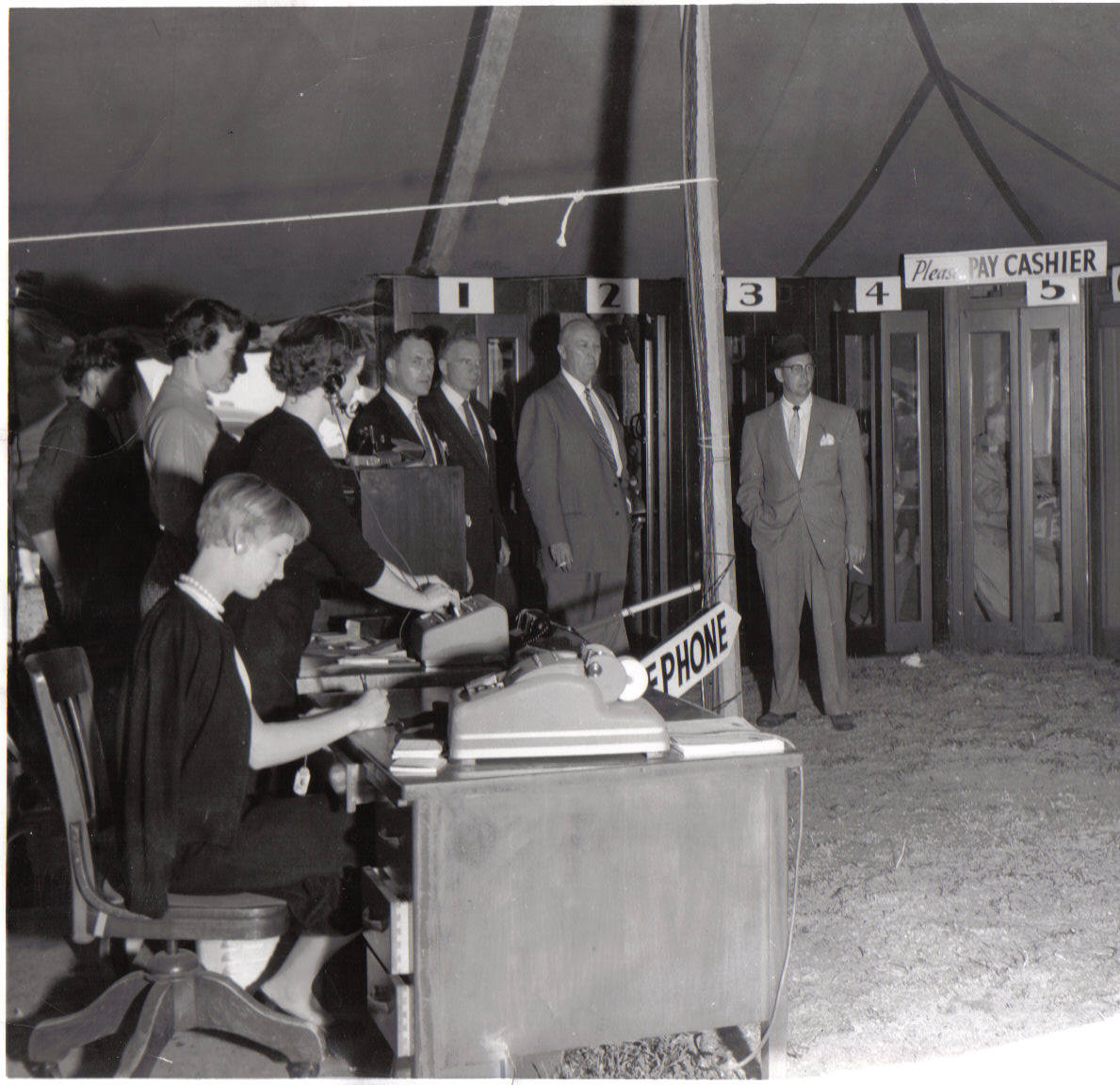
Jeanne seated in the communications tent
    A few years later, my husband and I were living in Cedar Rapids where I was employed in the business office of the telephone company.  One day, my manager tapped me and two other account representatives to take charge of the communications tent at a multi-state event called the Corn Picking Contest.  President Eisenhower would be there to say a few words to the crowd of over 100,000, and also putting in an appearance was the Democrat hopeful for the upcoming election, Senator John F. Kennedy.  The communications tent was a hub of activity in those low-tech days, for all the reporters called in news from one of the many phone booths in the large tent.  I and my co-workers would then get a call-back from the operator with charges. 
    Soon after we got set up, a flurry of activity outside the yet virtually empty tent heralded the arrival of someone important.  In walked a tall gentleman, who scanned the area, followed by the man himself.  Senator Kennedy immediately spotted us at our desks and with a friendly (and no doubt practiced) smile approached us with hand outstretched.  He introduced himself and chatted briefly about the venue and then departed.  It was over in a few minutes, but later I could say I shook the hand of a President of the United States in a rather intimate setting.  As far as Ike was concerned, I only saw him from a distance when someone lifted me onto the bed of a truck for a minute when he was speaking.
    It wasn’t until several years later that we made our home in Tennessee and I again came face to face with notables.  As I mentioned, this area was a hotbed of celebrities of a certain kind–and still is to a lesser extent today.  Shortly after taking up residence in the town, which was only about 16,000 at the time (it’s now about 50,000), I took our young boys to a small public pool.  It was there that I began to see Johnny Cash with his (or rather June’s) daughters, about the same age as my sons.   No one ever paid any attention to him, and he usually wandered around the perimeter while the girls swam.  I liked to take a rug and sit on the nearby grassy bank.  Occasionally, he also sat down, sometimes close, sometime far from me.  He might nod a little greeting, but never spoke; nor did I.  Hardly the man in black, he invariably wore jump suits in various colors.
    In reflecting about these brushes with the famous, I’ve decided that though we get a kick out of mentioning our encounters, they are really quite meaningless; we know these people are no different from anyone else, only more accomplished in certain areas.  One can admire them for their talents or even for their character, if indicated, such as my observation recently of Reba McEntire at a local restaurant.  As is my wont, I refused to stare, but I couldn’t help but observe that when she saw a young sailor dining alone, she sent word for him to join her party.  It was a thoughtful, entirely unnecessary act, one that probably went unnoticed by most people in the restaurant, but it will always color my regard for her.  That kind of memory is more meaningful, from my standpoint, than clustering around for an autograph that will probably fade or get lost over time.

Sunday, April 1, 2012

Downton Abbey Revisited

Branson and Sybil
    Allen Leech, Jessica Brown-Findlay, Dan Stevens, and Michelle Dockery: who’d a thunk those actors’ names would become household words to the PBS audience in a few short months?  Certainly not I, even though I am a long-time devotee of Masterpiece Whatever–Theater, Classic, or Mystery.  Although we in the Nashville viewing area haven’t had access to all the offerings, I’ve watched many programs through the years with great pleasure.  But of all those presentations, never have I, along with millions of others, been so taken with any show as with Downton Abbey.
    A beautiful setting, authentic costuming, many interwoven and compelling stories as well as an interesting transitional period in history all combine to keep viewers enthralled.   I’ve read pans on this series that call it a “soap opera”even as news stories tout it having a record audience of any PBS program in its history.  Pretty good soap opera, I’d say!  Upon seeing the initial episode, I was delighted with the excellent casting.  Nothing ruins a dramatic work for me more than actors playing  inappropriate roles.  Speaking of well-played roles, Elizabeth McGovern as Lady Grantham is the one American with a regular part.  Yea!  As for the characterizations, I was a little put off at the outset by the unpleasantness of Lady Mary and Lady Edith, the two older daughters of the Earl of Grantham, portrayed convincingly by Hugh Bonneville.  Of course, these unhappy girls had much to worry about with the oldest needing a new husband since her betrothed was a casualty of the Titanic, and her sister, the jealous and less pretty one, seeing little hope of catching any man for herself.  During the course of the dramas, however, both daughters would become changed and thereby redeem themselves.
    But despite these early blips in likability, I became entranced with the emerging circumstances that would inform the plots.  Scenarios began to unfold, one upon the other above and below the salt, quite a daunting task for the author, considering there are sixteen main characters.  A new heir to the title comes on the scene, the smooth and handsome Dan Stevens as Matthew, who fails initially to appeal to Lady Mary, and later has another personal difficulty to deal with.  Then Branson the chauffeur, well played by the engaging Allen Leech, finds himself attracted to the lovely Lady Sybil (Jessica Brown-Findlay), the youngest, most liberal, and most charming of the daughters.  Their slow-burning romance is fascinating, since Branson has decided views on the aristocracy, but ultimately satisfying, as well it should be, considering how daring it is.
    Downstairs, amid a kind of continual chaos, other romances are taking place, one between a housemaid, Anna, and a valet, the long-suffering Bates, with their complicated relationship; the other romantic alliance is one between a dying footman injured in World War One (a traumatic and important event in the story) and the kitchen maid.  Also among the servants are a couple of ruthless plotters who make life difficult for anyone they don’t like.
    If all this sounds impossibly complicated, I can assure you it is not, mainly because of the writing talents of the creator and writer, Julian Fellowes, whose credits also include Gosford Park.  In Downton Abbey, Fellowes uses a dramatic technique that works well in keeping the viewer always engaged and able to follow various plots and sub-plots.  Never was I confused as to who was doing what, mainly because each dramatic segment was never more than a few minutes long, cutting from one scene to the other.  Thus, it was easy to keep up with the different plots; longer scenes might require an update or review when going back and forth. 
    I was so enthusiastic about the series that I purchased the DVDs and have played them almost compulsively over and over.  Because of this, I have become aware of certain amusing authorial quirks, which writers seem prone to do in their writing.  One of my sons, for example, noted that in my mystery novel, Murder at Toll House, I said “anyhow” way too much.  Since it is an e-book, I was able to easily correct my habitual use of the word.  Julian Fellowes has virtually every character say, when surprised or shocked, “What?” rather than an extended question such as “What do you mean?” or “Is that so?” or “Why do you say that?”  No, everyone says, “What?”  In addition, I seem to have heard “quite right”  and "fetch" a few too many times.  This isn’t a big deal, and I don’t really criticize it as a serious fault, but I found it interesting as a fellow writer that even one as experienced and clever as Fellowes falls into inadvertent repetition. Sometimes I noted anachronistic intrusions, too, such as Matthew telling his mother that his fiancĂ© Lavinia was “sucking up” to her.  Really?  I doubt that was an Edwardian expression.  There were other glitches, but so few and so unimportant to the whole they do not bear mentioning.
    Altogether, as I have said from the start, I love the two productions so far, and I’m looking forward to Series Three, unfortunately not appearing on the PBS schedule until next January.  I and the other souls addicted to Downton Abbey will simply have to watch the first two series again and again on disks until our desire for more can be satisfied with the new production–and then hope for yet another and another.

Friday, March 2, 2012

White Knuckle Driving

    I learned to drive in a city, so maybe that’s why I still feel most comfortable going from stores to shops to malls and back even in fairly heavy traffic as opposed to highway driving.  I set off on any trip that takes me onto an interstate with a white-knuckled grip on the steering wheel. After only a few miles on the road, my neck begins to grow stiff--immovable, sometimes, and my fingers have turned into claws that are strangling the wheel.  And it’s all because of certain drivers that I consider road hazards.  Maybe my concerns will strike a chord with other nervous drivers.
    The most prominent and disturbing hazard that roams the interstates is the Careening Semi.  This behemoth is like all bullies everywhere.  Because of its size advantage, it rules the road; wherever it wants to go, it goes.  Even when it is sedately traveling the speed limit, it always seems to be advancing in a menacing way toward the innocent, undersized passenger car.  If a Careening Semi gets angered because a mere car has not moved out of its way quickly enough, it may give a frightening bellow of its horn as it threatens to run up over the back of the car.  In days of yore, truck drivers were called "knights of the road."  They helpfully blinked for safe passing or warned of lurking highway patrol cars and generally were paragons of safety and courtesy.  I have found a few latter-day truckers to follow these standards, but sadly more often than not, they strike me as capable of turning on the motorist with all the chilling fervor of the anonymous driver in Duel, a 1970s movie that realizes my worst fears.
    The second most aggravating hazard is the Spoiler.  You can spot these little devils in your rear-view mirror as fast moving vehicles darting from lane to lane, pulling in dangerously close, whipping onto the shoulder or turn lane around cars that don't move quickly enough.  These cars may be any make, but they are always either black or red, low slung, and have a saucy little spoiler on the back which seems to taunt, "Up yours!"  These cars are driven by teen-age boys or slightly older ones of a teenage mentality.  My tendency is to move away from the Spoilers, or even try to outrun them (I may be tense, but I'm not slow).  This maneuver is doomed to fail since they are egged on by any suggestion of competition.  With the Spoilers, slow and steady, the philosophy of the tortoise, wins the race.  Changing lanes unless absolutely necessary is risky, for even though they have quick reactions, you may not get in the lane fast enough, and they could easily side-swipe you.
    Drivers Lost in Space are not as dangerous as they sound, but they can be extremely annoying.   Lost in Space might be a mother trying to corral the back seat which is full of fighting, crying children, a businessman mentally going over his presentation, a woman checking her makeup or hair, or merely someone deep in thought or conversation with a passenger.  These drivers may be seen coming onto the interstate from a ramp without a glance at converging traffic.  If they noticed the "yield" sign, the letters didn't add up as an instruction to them personally.  The best way to avoid Lost in Space is to get by them quickly since all Lost in Spacers are narrowly focused if not myopic and could swerve in front of you at the drop of a hat.
    Lastly, Gramps is the driver who believes himself to be the safest on the road but is perhaps (after the Spoiler) the single greatest cause of accidents.  Gramps may be either sex but is almost always old (some younger persons are so afflicted), and maybe with eye problems.  Gramps may be spotted from behind as an apparently driver-less car in the right-hand lane going excessively slow.  Closer inspection reveals a short person who must view the road through the steering wheel.  They can, however, see out the side windows, and many seem to be out to look at the scenery, as are their passengers who stare intently out the window beside them.  Probably Gramps has learned to drive in another day and time.  I seldom drive in the far right lane, particularly when traveling on a hilly, curvy highway.  Coming up on Gramps suddenly at a high rate of speed means taking drastic avoidance measures--screeching brakes or running onto the shoulder.  When I see a long string of traffic creeping along, I know what I will find--an old timer nonchalantly leading the pack.
    No method of dealing with my fears and frustrations on the highway is perfect as one might guess from these descriptions, so I make every effort to keep my husband comfortable behind the wheel on trips, long or short, and encourage other relatives and friends always to be the designated driver as a favor to me and my nerves.

Monday, January 30, 2012

Glimpses of American Life in Prose Poems

An American Story          
                          
Berta was her name, a girl with woman’s eyes              
Slanted into the high bones of her cheeks.
The skin a soft tan, all suggesting a bygone
Melding with a native race in upper Norway.
She wasn’t pretty but playful and daring
Loving the merry parties her parents
And the neighbors gave for the many
Festive occasions that brought out the wine
And dancing to spirited fiddle playing.

Then came the Western Awakening,
With all the fervor of re-found faith.
It swept across Northern Europe
Led by a body of converted priests
Who declared the parties frivolous
If not evil with their drink and dance,
Keeping the faithful from sober thoughts.

The fiddles were banished to dark attics,
Their sound too seductive and plaintive.
But it was decreed that on certain
Occasions where music was allowed
Accordions were less sinful as a kind
Of small, secular organ that reminded folks
About the need for decorum and piety.

Berta silently railed against the changes,
Feeling stifled, and with her restless
Spirit she sought out the nearby harbor
To sink herself into the motion of the sea,
To watch the ships and men who glanced
At the womanly girl with slanted eyes.
A bold sailor in port for a week
Got her talking and then meeting
Where they came to know each other
Not wisely and too well.

Berta’s mother told her father about
The baby, so he cast around to find
Some likely lad that would take the girl
And the shame away from their proud name.
He paid a young man called Reinert
Fifty kroner if he would marry Berta
And leave for far flung parts

With an eye for the main chance and
Aware of vast lands in the New World,
Reinert agreed, and they sailed off
On their long journey, a sick-making
Affair for Berta, who before it was over
Lost the baby but not Reinert who stuck
By his bargain and made the best of it.

They settled in the great Midwest where
They raised crops along with two daughters
And four sons who made them proud,
The beginning of an American dynasty
Of farmers, housewives, teachers, lawyers.
After some years of rich harvests
Berta and Reinert welcomed her parents
To make their own fortune in this favored land.


Fear and Favor    
                      
In the summer of ‘49 the polio epidemic hit the Midwest.
No more swimming at the pool with my friends
Or staying up to watch our new TV until ten.
“Bedtime,” my mother would say with a little frown
To remind me that times were dangerous
And disease on the rampage.

We traveled to my aunt’s wedding in Minneapolis
Where children were dropping like flies.
I remember covering my mouth and nose
With my dad’s hankie as we drove through the streets.
Back safely home, I now and then
Dipped my head to my chest as a test to see
If paralysis was creeping up on me unbeknownst.

But all seemed well for me and my friends
Until one August evening, when my mother,
After a hushed conversation on the phone,
Sat me down in the kitchen and told me
That my friend Marilyn had been taken by ambulance
To the hospital, with polio, the bad kind, too--
Bulbar, which sometimes killed.

She went into an iron lung, a horrifying machine
That would save her life, I understood.
We later heard a strange thing;
Her sister had kissed her goodbye on the lips,
And hadn’t gotten sick, so we wondered
About the curious nature of this disease.
I was too young to visit her until she came home
Months later, from a place in Oklahoma
Where great strides had been made to keep limbs
From twisting and shrinking beyond use.

Marilyn did recover with only a slight limp that
Got better until it was unnoticed by most folks.
Yet she went to a school for the handicapped
Because she hadn’t the stamina for regular school.
I haven’t seen her for fifty years but I knew
She’d married and had a family of her own.
I now have heard the symptoms may return
Years later when victims thought themselves cured.
Again, fear must be stalking Marilyn
And I remember the summer of ‘49.


Big Wheels                              

It was while driving along
Through Arkansas that we felt
Oppressed, as if we didn’t belong,
Sandwiched between two semis,
With trucks rolling by on both sides.
Not just the big rigs that roam
Interstates and roads,
but bullying pickups and dualies.
We were outclassed, outsmarted,
In a word, small.

We drove farther south and west,
Trucks keeping up their threats,
Riding our bumper, honking, passing.
We stayed away from gas stations
With blaring signs of, “Truckers Welcome!”
We shopped a long while for a motel
Where the hulking beasts weren’t parked
And set off next morning at the crack of dawn
Hoping to steal a march on them.
But wise to the trick, they soon came along.

If Arkansas is a terminal for trucks,
Texas has to be a truck haven.
They live here, maybe breed here.
And worst of all, they seem fighting mad.
The other day while waiting at a stop light
We were rear-ended by a small truck.
At a local eatery we watched in horror
As a truck backed into our car like it wasn’t there
Often they pass me with no room to spare
Then forced by a red light to stop, pant, and paw.

We haven’t relented yet,
Refusing to give in to the mania.
Or maybe the truck that suits us
Hasn’t yet been made.
But I must admit I’ve been eyeing
Certain big wheels that take over the road
And I’ve wondered, really wondered
What it would be like to get behind the wheel
Of a gravel truck so I could yell,
“Just eat my dust, you all!”
              

And from the sky . . .

Far down our canal we spied a black cloud,
Startling, ominous.
It grew nearer and shattered
Into hundreds of cormorants
Who skimmed along the calm surface
And settled in to take a look around
Before they ducked and dived
To make their catch, tasty and alive.

Then we saw pelicans in their wake,
Ponderous, huge amidst the churning water,
Snatching fish too large for smaller gullets.
Soon egrets came in dazzling white array,
Posing with regal grace on piers.
Choosy, we thought, until we saw one
Die before our eyes with neck distended
From the greedy burden of its prey.

The great blue herons cruised in last
On the path of their heralds,
Sank down on grassy banks
To wait with the dignity of rank
For their meals to be brought on a tray.
Above the fray, the seagulls screamed and laughed
Assured they’d soon have the scraps.

Three mornings this spectacle occurred,
Then stopped, never that season to return.

Those in the know said these forays
Stripped the waters of breeding fish
Retreating from the chilling bay.
Guided by their instinctive need
They met their doom
On the quiet canal
While the birds shall live another day.                  
                  

                                            Jeanne Irelan
                                            January 2012

Friday, December 30, 2011

The Struggle Is All: Willa Cather

    Willa Cather's strong and sympathetic writing finds clearest expression in those novels that are set in the Midwestern United States, primarily because of the unique qualities of that land. The great-granddaughter of pioneers, I was born and reared there myself, so I can appreciate the sentiments she expresses through four novels in particular. Although Cather was born in Virginia, she moved with her parents to Nebraska at the age of nine in 1883, a move which had an enormous impact on her subsequent writing.  Living there through her university years, Cather had ample opportunity to observe the pioneers, mainly immigrants, who populated the region and toiled amid great hardships.  That harsh land which required so much of those who lived on it remained with her indelibly to serve as an inspiration for her novels set in that region, which historically has been characterized as having “an inhospitable climate, a boring landscape, and conventional inhabitants.”  Cather was acutely aware of this perception and quotes a New York critic who at the time her first Midwestern novel was released said, "I don't care a damn what happens in Nebraska, no matter who writes about it.”  But other critics since have not shared that view; Eudora Welty shows appreciation for Willa Cather's depiction of Midwesterners when she says, "There is not a trace of disparagement in her treatment of the least of her characters.  The irony of her stories is grave, never belittling; it is a showing of sympathy.”
    Cather herself moved to the East coast to establish her career, but visits to relatives in Nebraska reinforced her strong feelings of sympathy for those people who became the models for her protagonists in several novels and short stories.  Perhaps because of Cather's "showing of sympathy," posterity has had a continued interest in O Pioneers! (1913), My Antonia (l918), A Lost Lady (1923), and The Professor's House (1925), which can be considered her Midwestern novels.
    All of the principal characters in the four novels are connected to a greater or less degree with the land, which is employed as more than a setting for the story.  Most notably is O Pioneers!, where the land is introduced as so potent a force as to be a personality in its own right.  There and in the other three novels, the land is a featured player with a changing role, not so much for its effect on the characters as for its use as a counterpoise which indicates the moral force of each protagonist, i.e., the character of the land balances the character of the protagonist.
              Viewing the novels from an apparent chronology it seems obvious that as the plains become more readily cultivated and the population increases, the land figures less importantly in the lives of the main characters; therefore, one does not have to seek hidden or symbolic meaning as to its function.  But a closer look at the novels should make clearer Willa Cather's main thesis:  that the struggle of the immigrants on the virgin prairie symbolized the most difficult and most worthy endeavor of humankind--lofty, sacrificial striving toward an ideal: the essence of individualism.  Cather, in fact, seemed to resent the effects of "progress," in which the distractions of modern life–social pressures that desire conformity and require a money-grubbing mentality–deflected purposeful effort and constrained heroic gesture.   Cather became increasingly disturbed by the tendency of the times to look outside oneself for "success" in life.
              An unrepentant individualist, she viewed the New Deal with a kind of horror as the dawn of the age of the civil servant, whom she regarded en masse as "dreary petty men who took a mean pleasure in thwarting those who had energy, daring, and originality.”  The novels, under scrutiny, express Cather's desire to enlarge our sensibilities to her view of human potential and heroic achievement.  To Cather, the land comes to represent the protagonists themselves in these novels; how they use the land is how they "use" their lives.  The strengths exhibited by both the land and Alexandra Bergson in O Pioneers! form the standard by which characters in succeeding novels are to be judged.  In The Professor's House, the last novel chronologically, the author shows how the absence of struggle toward an ideal leads to spiritual poverty.  Here the land, a French garden, is relegated to an ignominious role of plaything for the Professor, and the Professor's life is as inconsequential as the garden with which he occupies his leisure moments.
              Now in our own times, when land has little importance in people’s lives, Cather’s thesis is interesting to ponder: that struggle is the great definer of character.  Since the symbolic importance of the land is now passĂ©, other symbols of the individual’s struggle may now suffice.   A person's life may be good, even happy, Cather seems to say, without taking the heroic path, but the transcendent life of real achievement can only follow from struggle toward a formulated ideal.

Tuesday, November 29, 2011

Celebration and Sorrow, 1950 (An edited excerpt from SNUSVILLE)

    The Lilleys always ate dinner on Thanksgiving and Christmas at Alma’s parents' farm with her brothers and sisters.  Joanie wouldn't have called her mother’s clan a particularly merry group, except for the rare times when Aunt Louise played the piano and a few voices joined in. 
    The winter holidays when Joanie was twelve were memorable.  The Lilleys arrived for Thanksgiving dinner with Alma's four pies--two coconut creams and two pumpkins.  All the women brought their specialties to the dinner.  Uncle Roy's wife, Lillith, always made the dressing, a mild concoction to suit Scandinavian tastes with a hint of the exotic in her addition of chopped black olives.  Louise, being single and somehow exempt from more rigorous cooking, brought relish trays and rolls, while Aunt Rose's husband, Helmar, furnished the giant bird which he baked with loving attention to a crisp, golden brown.
    Just as Joanie began to take her place at the kitchen table to eat with her younger cousins, Louise grabbed her arm and marched her into the dining room.  "You're too old to eat out there with the kiddies.  It's time you sat with the grown-ups."  Well!  Joanie’s face burned with pleasure though no one seemed to notice this big change.  The meal didn’t begin until her grandfather gave the blessing, ending it in some Norwegian phrase, and after her plate of food was handed to her, Joanie ate her dinner quietly listening to the adults talk.
    "Can't make a nickle with hog prices so low."  This from Roy, who always complained loudly about his farming.
    Uncle Ralph nodded his agreement to his brother's concerns but as usual didn't say anything.  Grandpa ate with quiet appreciation.  Joanie’s cousin Geraldine and her boyfriend Tony Marello sat together, while the others were segregated--the men sitting near Grandpa and the women around Grandma.  Geraldine's voice occasionally rang out, competing with Roy's.
    Joanie felt free to look around the table and observe how nice everything looked.  The good china had been taken out of the built-in china cabinet with the leaded glass panes.  Haviland, her mother said, ordered by her grandfather when he built this place in 1915.  No decorations, however.  Such things were considered frivolous by her grandmother.  After dinner the women cleared the table and washed dishes.  Grandma had left immediately following the meal to take her nap, while Grandpa sat in his rocker and dozed, his face lightly touched by the lengthening rays of the sun.
***
    Christmas ordinarily would have been a repeat of the Thanksgiving celebration with the added excitement of gift-giving, but this year was different.  Grandpa Ekdahl died ten days before Christmas of a massive coronary thrombosis that killed him instantly.  It happened on a Saturday night just as the Lilleys were beginning dinner.  Joanie answered the phone and heard her uncle Ralph asking for her mother in such a strange, hollow voice she felt frightened.
    She went to her grandfather's funeral, her first, with her parents the following Saturday at the Lutheran church in Bethany.  She didn't hear a word the minister said, but at one point Ralph, silent Ralph, bent his head into his hands and shook with sobs.  Nothing could have impressed her more.  But the others, as far as she could tell, were as dry in the eye as the stiff old body with the dry browned skin that had been Nels Ekdahl.
    After the funeral and the trip in the painful cold to the burial site on a windy hill, everyone hurried back to the farmhouse for refreshments and subdued conversation about matters that Joanie decided were not quite fitting.  Shouldn't they have talked about her grandfather?  She continued to think about him the following week and how he had passed out of their lives so easily, so completely, his passing hardly noticed except for the slight, tearful convulsion of Uncle Ralph the day of the funeral. 
    Christmas plans proceeded.  By the time the Lilleys arrived for the occasion at the farm, packages were clumped around the base of the tree and the table was set for dinner.  A large ham was being carefully whittled into slices by Helmar and placed on the huge platter around kumla, grated potatoes cooked in ham broth.
    After dinner, the men congregated in the living room while the women cleaned up the dishes.  Joanie wandered into the dining room and saw Geraldine, sitting in grandpa's big wicker rocker by the low window overlooking the side garden.  Joanie remembered Grandpa dozing there Thanksgiving, caught by a pale November sun as in a distant floodlight that exposed his weathered face.  No sunlight streamed in today.
    "Hi, Geraldine.  I wonder when we can open the presents."
    Her cousin turned.  No smile, but her voice was pleasant.  "You know this bunch.  They can't let themselves have any fun until all the work is done.  Heaven forbid they leave a dirty dish or do anything out of order."
    Joanie knew in some deep, hidden place what Geraldine meant.  She wanted to know more.  "Why are they like that?"
    "Mainly because of the old man.  At least, he was the worst.  Rigid as a post, no give in him that anyone could see."
    "Didn't you like Grandpa?"
    "Sure, I did, kid; you don't get it.  He was a softie inside, but these Norwegians can't let anything get out.  It has to explode from them.” She cocked her head at Joanie.  "Ever hear the word love mentioned around here?"
    "No."  It was true!  Geraldine had said something marvelous and true.  She knew about emotions exploding, too.  Sometimes her feelings ran so strongly in her she would have to cry or give her mother a hug.  Alma would chide her.  "Get control of yourself.  Do you want to end up like poor Paul, raving?"  Her father’s brother had had a “breakdown.”
    "Oh, yeah, I know about these Norwegians," Geraldine nodded sagely.   “They used to have prayer meetings here, and I witnessed one of them.  My God, did they ever howl then!  They'd fall all over themselves confessing their sins."
    "Grandpa did all that, too?"  Impossible to imagine the man in the throes of such fervor.
    "He was the most emotional of them all.  Didn't you ever see him cry sometimes?"
    "I've heard Mom say that Grandpa was tender-hearted and cried, but I never saw him do that."  Her own eyes filled with tears that overflowed as she thought of her grandfather, his whole life bound into uncomfortable silence by something.  What?   
    Christmas proved to be exciting, even this year.  Aunt Rose had drawn Joanie’s name and gave her a bottle of Tigris perfume, a grown-up scent that thrilled her.  Grandpa, though not mentioned by anyone, seemed to be present in spirit, quietly approving the sedate celebration that marked all their big occasions.

Tuesday, November 1, 2011

My Love Affair with Old Things

A couple of old things, Jeanne and Max
    I read many years ago that Cary Grant had a thirty-year-old top coat he wore regularly because it was perfectly good, and he liked it.  His view about something old echoed my own feelings.  As children we used to sing a ditty about making new friends but keeping the old; “one is silver, the other gold.”  Do children sing this anymore?  Do people treasure old companions, old clothes, old furniture, and other old things?  I do.
    I live in a part of the country (the South) which is known for its appreciation of the past.  Yet for all the Daughters of the Confederacy, the treasured heirlooms, the frequent viewings of Gone with the Wind, this culture is also succumbing to a tendency that runs rampant through our society.  Since the 1920s, when "modern" became a revered word, Americans have come to value whatever is the latest anything.  Perhaps this is because of our inventiveness, our “go get'em” philosophy which has propelled this nation into the forefront of virtually every technological and scientific advancement.  Commercials touting detergents or cosmetics or vacuum cleaners insist we buy their "new, improved" product.  We don’t question the validity of these spiels; yet I understand ad people in Britain seldom use the term "new" in their ads.  They know that their potential customers would ask, “What's wrong with the product, then, if it keeps needing improvement?”  In most places around the world people are allowed the natural phenomenon of getting attached to old things.  They recognize that old things are appealing and important in a way very different from the novelty and shine of the new, that old things can become as valued as old friends.
    For some mysterious reason, I have seldom been lured by new things.  I like old furniture, jewelry, and clothes, and when we moved a few years ago to another state, we had our thirty-five-year old washer hauled off for practical reasons.  It was ugly and noisy but still working.   I also have a predilection for old cars as long as they’re reliable.  That along with my love for other old things probably stems from a two-fold influence–my appreciation for classic design with the integrity from a more substantial age coupled with my parents' attitude about possessions.
    My mother as a homemaker considered herself a “good manager,” carefully husbanding my father's modest income.  Because of her energy and ingenuity, we were able to live in a nice house amid comfortable, well-kept furnishings. Other than his family, my father took care of only one thing in his life: he gave fanatic attention to his cars.  For Dad, the automobile was a wondrous thing which he never took for granted.  To his dying day, his car was his horse, groomed and petted like a champion of its class.  He spoiled them–no car deserves to have its engine wiped off after a trip to the store.
    If I recited a list of all the aged things which surround me, it would sound like a not-very-particular museum inventory.  I live among furniture and accessories that may be anywhere from twenty to three hundred years old.  Since moving to Tennessee many years ago, my husband and I have scouted antique malls, thrift shops, and garage sales to find treasures.  I admit I do appreciate the electronic age and many of its products.  In fact, I have a useful supply of those new-fangled devices, so I don’t consider myself a Luddite, but I also put those inventions that are constantly becoming obsolete in the proper perspective.
    This brings me to the relationships which we nurture throughout our lives with care, love, and tolerance–those of our friends and family, and even our animals.  (We’ve had only two dogs in our married life, a poodle that lived to be seventeen and currently, Louie, a peppy fourteen-year-old papillon.)  But longevity in relationships applies most especially to our partners in life.  The fact that my husband and I have lived happily together for so long make us something of an admired novelty for our grandchildren, who seem amazed at anything quite that long-term.
     Unlike the Europeans, the Orientals, the Africans, for example, most Americans have not understood the value of old things.  As a people we tend to abandon anything that begins to get troublesome--whether it's a couch, a house, or a spouse.  But old things reflect our personal values as well as our collective memory, which in turn informs our attitudes about the future.  The past doesn’t become real through text books.  Instead, we can best remember another age by the artifacts of that age and by tales from elders; those memories combine to make up our identity. Old things represent more than their physical being or even their usefulness.  They have a history, and as far as I’m concerned, they will have a future.